English Grammar Syntax and Types of Sentences: Complete Guide for Beginners
How are English sentences formed? What is syntax? What is the difference between a phrase and a clause? And how many types of sentences are there?
If you are learning English grammar, understanding sentence structure is one of the most important steps you can take.
You may already know nouns, pronouns, verbs, adjectives, and other parts of speech. The next step is learning how these words work together to create meaningful sentences.
What You Will Learn
- What syntax means
- How English sentences are organized
- What a subject is
- What a predicate is
- What a verb does in a sentence
- What an object is
- Basic English sentence patterns
- Subject + Verb structure
- Subject + Verb + Object structure
- Subject + Verb + Complement structure
- The difference between a phrase and a clause
- Independent and dependent clauses
- Simple, compound, complex, and compound-complex sentences
- Declarative sentences
- Affirmative and negative sentences
- Interrogative sentences
- Imperative sentences
- Exclamatory sentences
- Common sentence-structure mistakes
What Is Syntax?
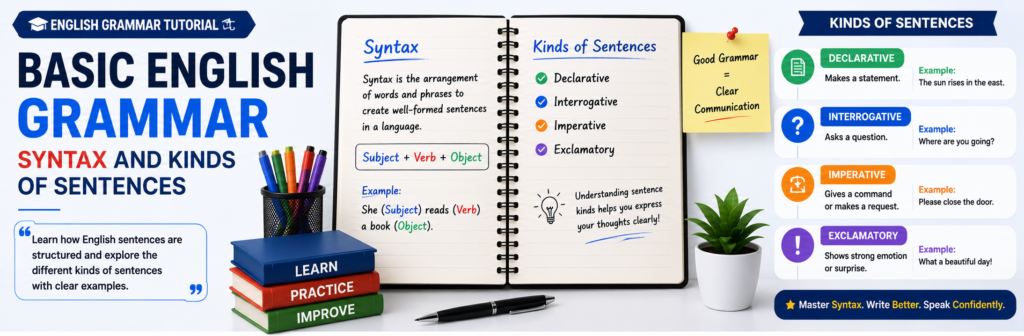
Syntax is the way words, phrases, and clauses are arranged to form grammatically meaningful sentences.
In simple words:
Syntax is the structure or arrangement of words in a sentence.
Look at these examples:
She reads books.
This sentence follows a natural English word order.
Now compare it with:
Books reads she.
The individual words are recognizable, but the arrangement is not the normal English sentence pattern.
This is why syntax is important.
English relies heavily on word order to communicate relationships between the parts of a sentence.
Why Is Syntax Important?
Correct syntax helps readers and listeners understand exactly what you mean.
Compare:
The dog chased the boy.
with:
The boy chased the dog.
The same nouns and verb are used, but changing the word order changes the meaning.
In the first sentence:
The dog performs the action.
In the second:
The boy performs the action.
Therefore, learning syntax helps you:
- Build correct sentences
- Communicate clearly
- Write better English
- Understand what you read
- Speak more naturally
- Avoid confusing word order
The Basic Parts of a Sentence
A sentence can contain several different components.
Some of the most important are:
- Subject
- Verb
- Object
- Complement
- Modifier
Let’s understand the most important ones first.
What Is a Subject?
The subject is the person, animal, thing, or idea that the sentence is about.
In many sentences, the subject performs the action expressed by the verb.
Examples
Ali plays football.
The teacher explained the lesson.
My brother is sleeping.
The computer is working.
In these examples:
- Ali = subject
- The teacher = subject
- My brother = subject
- The computer = subject
Easy Way to Find the Subject
Ask:
Who or what is the sentence about?
For example:
The children are playing outside.
Who is playing?
The children.
Therefore, the children is the subject.
What Is a Predicate?
The predicate is the part of a clause that says something about the subject. It normally contains the verb and may contain objects, complements, and other information.
Consider:
Ahmed plays cricket.
The sentence can be divided into:
Subject: Ahmed
Predicate: plays cricket
Another example:
The small dog is sleeping under the table.
Subject: The small dog
Predicate: is sleeping under the table
The predicate tells us what the subject does, is, or experiences.
Subject and Predicate Examples
| Sentence | Subject | Predicate |
|---|---|---|
| Ali runs. | Ali | runs |
| Sara reads books. | Sara | reads books |
| The baby is sleeping. | The baby | is sleeping |
| My friends visited us. | My friends | visited us |
| The computer works well. | The computer | works well |
This is one of the simplest ways to begin understanding sentence structure.
What Is a Verb?
A verb expresses an action, state, or occurrence.
Examples:
- run
- eat
- write
- read
- sleep
- think
- become
- seem
- is
- have
Examples
She writes every day.
They play football.
He is tired.
We have a car.
The verb is a central part of the sentence because it tells us what is happening or what state something is in.
What Is an Object?
An object is a word or group of words that receives or is affected by the action of a transitive verb.
For example:
I bought a book.
The subject is:
I
The verb is:
bought
The object is:
a book
The action of buying is directed toward the book.
Another example:
She opened the door.
She = subject
opened = verb
the door = object
How to Find the Object
A useful beginner technique is to ask:
What? or Whom?
after the verb.
Example:
Ahmed reads a book.
Ahmed reads what?
A book.
Therefore, a book is the object.
Another example:
Sara called her friend.
Sara called whom?
Her friend.
Therefore, her friend is the object.
However, not every verb has a direct object.
For example:
The baby slept.
There is no direct object after slept.
Subject + Verb
The simplest sentence pattern is:
Subject + Verb
Examples:
Birds fly.
Children laugh.
Dogs bark.
The baby sleeps.
In these sentences, the subject performs an action and the sentence is complete without a direct object.
Subject + Verb + Object
Another very common English pattern is:
Subject + Verb + Object
Examples:
I read books.
She drinks water.
He plays football.
They watched a movie.
Let’s analyze:
She drinks water.
She = Subject
drinks = Verb
water = Object
This pattern is extremely common in English.
Subject + Linking Verb + Complement
Some sentences use a linking verb followed by a complement rather than a direct object.
Examples:
She is happy.
Ali became a doctor.
The soup smells delicious.
The words happy, a doctor, and delicious provide information about the subject.
Common linking verbs include forms of:
- be
- become
- seem
- appear
- feel
- look
- smell
- taste
Subject + Verb + Indirect Object + Direct Object
Some sentences contain two objects.
Example:
She gave me a book.
Here:
She = Subject
gave = Verb
me = Indirect Object
a book = Direct Object
The indirect object generally identifies the recipient or beneficiary, while the direct object identifies what was given.
Another example:
My father bought me a laptop.
me = indirect object
a laptop = direct object
Basic English Sentence Patterns
Here are some useful sentence patterns for beginners:
| Pattern | Example |
|---|---|
| S + V | Birds fly. |
| S + V + O | She reads books. |
| S + V + C | He is happy. |
| S + V + IO + DO | She gave me a gift. |
| S + V + O + C | They elected him president. |
Where:
S = Subject
V = Verb
O = Object
C = Complement
IO = Indirect Object
DO = Direct Object
Learning these patterns can make sentence construction much easier.
What Is a Phrase?
A phrase is a group of words that functions as a unit within a sentence but does not contain a complete subject-verb relationship forming an independent clause.
Examples:
under the table
in the classroom
a very beautiful garden
after the meeting
with my friends
A phrase can add important information to a sentence.
Example
The cat is sleeping under the table.
under the table is a prepositional phrase.
It tells us where the cat is sleeping.
What Is a Clause?
A clause is a group of words that contains a subject and a verb.
For example:
She is reading
This contains:
She = subject
is reading = verb phrase
Therefore, it is a clause.
Another example:
because he was tired
This also contains a subject and verb:
he = subject
was = verb
But it cannot normally stand alone as a complete sentence.
Independent Clause
An independent clause contains a subject and a verb and expresses a complete thought.
Example:
She is studying.
This can stand alone as a sentence.
Another example:
I finished my homework.
It is complete by itself.
Dependent Clause
A dependent clause, also called a subordinate clause, contains a subject and a verb but does not normally express a complete thought by itself.
Example:
because she was tired
This leaves the reader asking:
What happened because she was tired?
We can combine it with an independent clause:
She went to bed because she was tired.
Now the complete sentence makes sense.
Phrase vs Clause
This distinction is very important.
| Phrase | Clause |
|---|---|
| May not contain a subject-verb relationship | Contains a subject and a verb |
| Usually cannot stand alone | May or may not stand alone |
| Functions as part of a sentence | Can form part or all of a sentence |
| Example: under the table | Example: she was sleeping |
Example
Phrase:
in the classroom
Clause:
the students are studying
Kinds of Sentences by Structure
English sentences can be classified by their grammatical structure.
The four major structural types are:
- Simple sentence
- Compound sentence
- Complex sentence
- Compound-complex sentence
Let’s understand each one.
1. Simple Sentence
A simple sentence contains one independent clause.
It can have a compound subject or compound predicate, but it still contains only one independent clause.
Examples
Ali plays football.
Sara reads books.
My brother and sister study English.
The dog barked and ran away.
The last example has two verbs, but it still contains only one independent clause.
2. Compound Sentence
A compound sentence contains at least two independent clauses joined together.
The clauses are often connected using coordinating conjunctions such as:
and, but, or, so, yet, for, nor
Examples
I wanted to go outside, but it was raining.
She studied hard, and she passed the examination.
You can take the bus, or you can walk.
Each side can stand as a complete sentence.
For example:
I wanted to go outside.
and:
It was raining.
Joining them creates a compound sentence.
3. Complex Sentence
A complex sentence contains:
One independent clause + at least one dependent clause
Examples:
I stayed home because it was raining.
When the teacher arrived, the students became quiet.
She smiled although she was tired.
The dependent clause provides additional information but cannot normally stand alone.
Common subordinating conjunctions include:
- because
- although
- when
- while
- if
- unless
- after
- before
- since
- while
4. Compound-Complex Sentence
A compound-complex sentence contains at least:
- Two independent clauses
- One or more dependent clauses
Example:
I wanted to go outside, but I stayed home because it was raining.
Independent clause:
I wanted to go outside.
Independent clause:
I stayed home.
Dependent clause:
because it was raining.
This type of sentence is more advanced but becomes easier once you understand independent and dependent clauses.
Kinds of Sentences by Purpose
Sentences can also be classified according to what they do.
The four major types are:
- Declarative
- Interrogative
- Imperative
- Exclamatory
Let’s examine each one.
1. Declarative Sentence
A declarative sentence makes a statement or gives information.
It normally ends with a period.
Examples:
I live in Pakistan.
She is a teacher.
The sun rises in the east.
We are learning English grammar.
Declarative sentences can be either affirmative or negative.
Affirmative Sentence
An affirmative sentence states that something is true or happening.
Examples:
She is a student.
He plays cricket.
They live in Karachi.
I like English.
Negative Sentence
A negative sentence expresses negation.
Common negative structures use words such as:
- not
- no
- never
- nobody
- nothing
- nowhere
Examples:
She is not a student.
He does not play cricket.
They never arrive late.
There is no water in the bottle.
Important Note
Negative sentences are not formed simply by adding not to every verb.
For example:
Incorrect:
She not likes tea.
Correct:
She does not like tea.
The correct structure depends on the verb and tense.
2. Interrogative Sentence
An interrogative sentence asks a question.
It normally ends with a question mark.
Examples:
What is your name?
Where do you live?
Are you a student?
Did you finish your homework?
There are several kinds of questions.
Yes/No Questions
These questions can usually be answered with yes or no.
Examples:
Are you ready?
Do you like English?
Did he call you?
Wh-Questions
These questions commonly begin with words such as:
- What
- Where
- When
- Why
- Who
- Which
- Whose
- How
Examples:
What are you doing?
Where do you live?
Why are you late?
How did you solve the problem?
3. Imperative Sentence
An imperative sentence gives a command, instruction, request, warning, or advice.
The subject you is often understood rather than stated.
Examples:
Open the door.
Please sit down.
Study carefully.
Don’t touch that.
Take an umbrella.
The tone depends on the situation.
Compare:
Close the door.
with:
Please close the door.
The second sounds more polite.
4. Exclamatory Sentence
An exclamatory sentence expresses strong emotion or reaction.
It normally ends with an exclamation mark.
Examples:
What a beautiful day!
How wonderful!
I can’t believe we won!
That is amazing!
Exclamatory sentences can express:
- Surprise
- Happiness
- Excitement
- Anger
- Sadness
- Admiration
Declarative vs Interrogative vs Imperative vs Exclamatory
| Type | Purpose | Example |
|---|---|---|
| Declarative | Gives information | She is a teacher. |
| Interrogative | Asks a question | Is she a teacher? |
| Imperative | Gives command/request | Open the door. |
| Exclamatory | Expresses strong emotion | What a beautiful view! |
One Idea in Four Sentence Types
Let’s use the idea of opening a door.
Declarative
Ahmed opens the door.
Interrogative
Does Ahmed open the door?
Imperative
Open the door.
Exclamatory
What a beautiful door!
This comparison helps you understand how sentence purpose changes the structure and punctuation.
Common Sentence Structure Mistakes
Mistake 1: Incorrect Word Order
Incorrect:
English I learning am.
Correct:
I am learning English.
English generally follows recognizable word-order patterns.
Mistake 2: Missing the Verb
Incorrect:
She a teacher.
Correct:
She is a teacher.
A finite verb is required for a standard complete English clause.
Mistake 3: Subject-Verb Agreement
Incorrect:
He play football.
Correct:
He plays football.
Incorrect:
They plays football.
Correct:
They play football.
The verb form must agree appropriately with the subject.
Mistake 4: Confusing Object and Subject
Compare:
The dog chased the boy.
The dog is the subject.
The boy is the object.
Now change the word order:
The boy chased the dog.
The boy becomes the subject.
The dog becomes the object.
Word order can therefore change who performs the action.
Mistake 5: Treating Every Group of Words as a Sentence
Because I was tired.
This is normally a dependent clause, not a complete sentence.
Complete it:
I went to bed because I was tired.
Mistake 6: Using a Comma Where a Full Stop Is Needed
Incorrect:
I went home, I was tired.
This is a comma splice in standard written English.
Better:
I went home because I was tired.
or:
I went home, and I was tired.
or:
I went home. I was tired.
Sentence Building Practice
Let’s build a sentence step by step.
Start with a subject:
The student
Add a verb:
The student reads
Add an object:
The student reads a book.
Add a location:
The student reads a book in the library.
Add a time expression:
The student reads a book in the library every afternoon.
We started with a very small sentence and gradually added information.
This is one of the best ways to understand syntax.
Practice Exercise
Identify the requested part of each sentence.
1.
The boy plays football.
What is the subject?
2.
Sara reads a book.
What is the object?
3.
The children are playing outside.
What is the verb phrase?
4.
I stayed home because it was raining.
Which part is the dependent clause?
5.
Please close the window.
What type of sentence is this?
6.
Where do you live?
What type of sentence is this?
7.
What a beautiful painting!
What type of sentence is this?
8.
She studied hard, and she passed the examination.
What type of sentence is this by structure?
Answers
1. The boy → Subject
2. a book → Object
3. are playing → Verb phrase
4. because it was raining → Dependent clause
5. Imperative sentence
6. Interrogative sentence
7. Exclamatory sentence
8. Compound sentence
Quick Revision
Remember these basic concepts:
Syntax
The arrangement of words and grammatical units in sentences.
Subject
The person, thing, or idea the clause is about.
Predicate
The part of the clause that says something about the subject.
Verb
Expresses an action, state, or occurrence.
Object
A constituent that can receive or be affected by the action of a transitive verb.
Phrase
A group of words functioning together as a unit that does not form a complete independent clause.
Clause
A group of words containing a subject and a verb.
Sentence Structure Cheat Sheet
Basic Pattern
Subject + Verb
Birds fly.
Common Pattern
Subject + Verb + Object
She reads books.
Linking Pattern
Subject + Linking Verb + Complement
He is happy.
Two-Object Pattern
Subject + Verb + Indirect Object + Direct Object
She gave me a gift.
Simple Sentence
One independent clause
I study English.
Compound Sentence
Independent clause + independent clause
I study English, and my brother studies mathematics.
Complex Sentence
Independent clause + dependent clause
I study English because I enjoy it.
Compound-Complex Sentence
Two or more independent clauses + dependent clause
I study English because I enjoy it, and my brother studies mathematics because he likes numbers.
Frequently Asked Questions
What does syntax mean in English grammar?
Syntax refers to the way words and grammatical units are arranged to form meaningful and grammatically structured sentences.
What is the basic English sentence pattern?
A common basic pattern is:
Subject + Verb + Object
For example:
She reads books.
However, English uses many other sentence patterns.
What is the difference between a subject and an object?
The subject is typically the person or thing performing the action or being described, while the direct object is typically the person or thing affected by a transitive action.
Example:
Ali kicked the ball.
Ali = subject
the ball = object
What is a phrase?
A phrase is a group of words functioning together as a unit but not forming a complete independent clause.
Example:
under the table
What is a clause?
A clause contains a subject and a verb.
Example:
She is reading.
What are the four sentence types by purpose?
They are:
- Declarative
- Interrogative
- Imperative
- Exclamatory
What are the four sentence types by structure?
They are:
- Simple
- Compound
- Complex
- Compound-complex
What is an affirmative sentence?
An affirmative sentence expresses a positive statement rather than a negative one.
Example:
She likes English.
What is a negative sentence?
A negative sentence expresses negation.
Example:
She does not like coffee.

About Techanees
Techanees is a technology platform sharing simple tutorials, useful guides, web development tips, and the latest tech updates for beginners and enthusiasts.
Caliente Apuestas… just looked it up. Looks decent, but I wanna hear from real players first. Any hot tips you can share before I jump in?