Basic English Grammar for Beginners: Parts of Speech, Vowels, Consonants & Examples
English grammar is the foundation of effective communication. If you want to improve your English speaking, writing, reading, or understanding, learning basic grammar is an excellent place to start.
Many beginners try to memorize complicated grammar rules without first understanding how words work inside a sentence. This can make English feel difficult and confusing.
The good news is that grammar becomes much easier when you learn it step by step.
What You Will Learn
- The English alphabet
- Vowels and consonants
- What grammar means
- What parts of speech are
- The eight major parts of speech
- Different kinds of nouns
- Personal and demonstrative pronouns
- Main and auxiliary verbs
- Regular and irregular verbs
- Transitive and intransitive verbs
- Adjectives
- Adverbs
- Prepositions
- Conjunctions
- Interjections
- Basic sentence examples
- Common beginner grammar mistakes
What Is English Grammar?
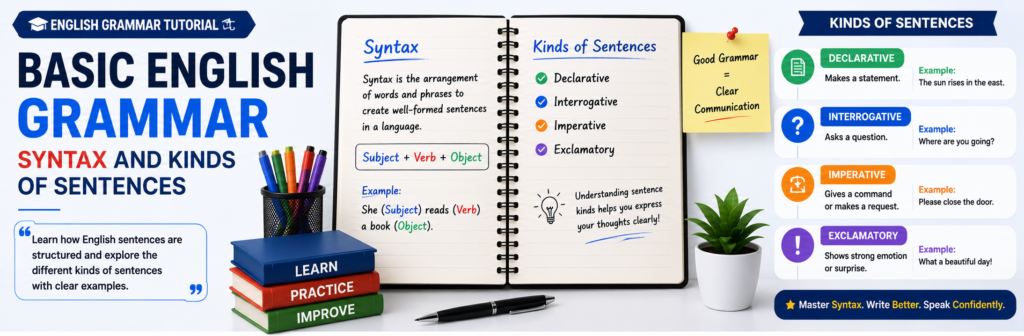
Grammar is the system of rules and patterns that helps us arrange words correctly to communicate meaning.
Consider these two sentences:
She reads a book.
and
Reads book she a.
Both sentences contain similar words, but only the first sentence follows a natural English structure.
Grammar helps us understand:
- Which words should be used
- Where words should be placed
- How words change
- How sentences are formed
- How ideas are connected
Learning grammar doesn’t mean memorizing every rule at once. It means gradually understanding how English works.
The English Alphabet
The modern English alphabet contains 26 letters.
They are:
A, B, C, D, E, F, G, H, I, J, K, L, M, N, O, P, Q, R, S, T, U, V, W, X, Y, Z
These letters are used to form words.
For example:
- C + A + T = cat
- B + O + O + K = book
- T + A + B + L + E = table
Letters form words, and words can then be combined to create phrases and sentences.
Vowels and Consonants
The letters of the English alphabet are commonly divided into two groups:
- Vowels
- Consonants
Understanding vowels and consonants is one of the first steps in learning English pronunciation and spelling.
What Are Vowels?
The five main vowel letters in English are:
A, E, I, O, U
For example:
- A in apple
- E in elephant
- I in ink
- O in orange
- U in umbrella
The letter Y can also represent a vowel sound in some words, such as:
- my
- happy
- gym
However, for basic grammar and alphabet learning, beginners usually start with the five main vowel letters: A, E, I, O, and U.
Examples
Look at the following words:
write
The vowel letters are i and e.
small
The vowel letter is a.
computer
The vowel letters are o, u, and e.
What Are Consonants?
Consonants are the other letters of the English alphabet besides the main vowel letters.
They include:
B, C, D, F, G, H, J, K, L, M, N, P, Q, R, S, T, V, W, X, Y, Z
The letter Y can sometimes represent a vowel sound, so its classification depends on how it is used.
Examples
In the word book:
- B = consonant
- O = vowel
- O = vowel
- K = consonant
In the word school:
- S = consonant
- C = consonant
- H = consonant
- O = vowel
- O = vowel
- L = consonant
What Are Parts of Speech?
Words perform different jobs in sentences.
For example:
Ali plays football.
Here:
- Ali names a person.
- plays tells us what Ali does.
- football names a thing or activity.
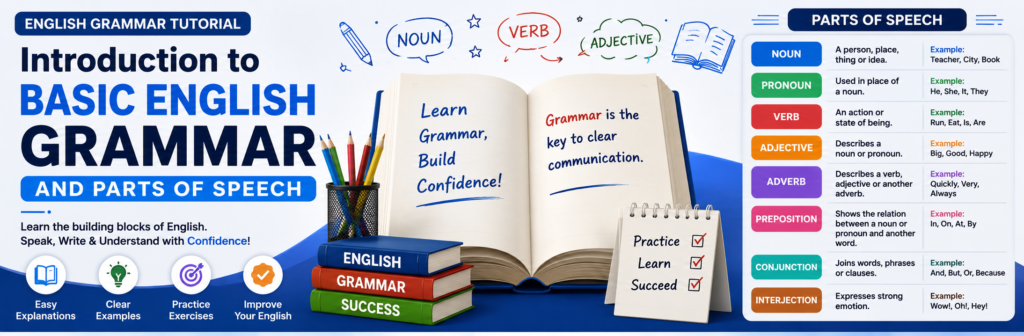
Because words perform different grammatical functions, English grammar traditionally divides words into different categories called parts of speech.
The eight major parts of speech are:
| No. | Part of Speech | Main Function |
|---|---|---|
| 1 | Noun | Names a person, place, thing, or idea |
| 2 | Pronoun | Replaces a noun |
| 3 | Verb | Shows an action, state, or occurrence |
| 4 | Adjective | Describes or modifies a noun or pronoun |
| 5 | Adverb | Modifies a verb, adjective, or adverb |
| 6 | Preposition | Shows a relationship between words |
| 7 | Conjunction | Connects words, phrases, or clauses |
| 8 | Interjection | Expresses a sudden feeling or reaction |
Let’s study each one carefully.
1. Noun
A noun is a word used to name a person, place, thing, animal, or idea.
Examples:
- Person: teacher, student, Ali
- Place: school, Karachi, park
- Animal: cat, horse, elephant
- Thing: book, computer, chair
- Idea: happiness, freedom, honesty
A simple way to remember a noun is:
A noun is a naming word.
Examples in Sentences
Ahmed is a student.
Ahmed and student are nouns.
The cat is sleeping.
cat is a noun.
Honesty is important.
Honesty is a noun because it names an idea or quality.
Kinds of Nouns
Nouns can be divided into several categories.
The commonly taught categories include:
- Proper noun
- Common noun
- Collective noun
- Abstract noun
- Material noun
Let’s understand them one by one.
Proper Noun
A proper noun is the specific name of a particular person, place, organization, day, month, or other named entity.
Proper nouns normally begin with a capital letter.
Examples:
- Ahmed
- Pakistan
- Karachi
- Monday
- January
- Microsoft
Sentence
Ahmed lives in Karachi.
Ahmed and Karachi are proper nouns.
Common Noun
A common noun refers to a general person, place, animal, thing, or concept rather than a specific named individual.
Examples:
- boy
- girl
- city
- country
- school
- teacher
- car
- computer
Compare:
city → common noun
Karachi → proper noun
Collective Noun
A collective noun refers to a group of people, animals, or things considered as a unit.
Examples:
- team
- family
- class
- flock
- crowd
- committee
Examples
Our team won the match.
The class is preparing for the examination.
A flock of birds flew across the sky.
Abstract Noun
An abstract noun names an idea, quality, feeling, state, or concept that cannot normally be experienced as a physical object.
Examples:
- honesty
- kindness
- happiness
- courage
- freedom
- beauty
- knowledge
Examples
Honesty is a valuable quality.
She showed great courage.
You cannot normally touch courage or honesty like you can touch a book or chair, but you can understand or experience these ideas.
Material Noun
A material noun refers to a substance or material from which things can be made or which occurs naturally.
Examples include:
- gold
- silver
- water
- wood
- iron
- cotton
- wheat
Example
The ring is made of gold.
The table is made of wood.
2. Pronoun
A pronoun is a word used in place of a noun.
Pronouns help us avoid unnecessary repetition.
Consider this example:
Ahmed is a student. Ahmed studies English. Ahmed likes grammar.
Repeating “Ahmed” in every sentence sounds unnatural.
We can replace the repeated noun with a pronoun:
Ahmed is a student. He studies English. He likes grammar.
Here, he is a pronoun.
Common pronouns include:
I, you, he, she, it, we, they, me, him, her, us, them
Personal Pronouns
Personal pronouns refer to people or things according to their grammatical person and number.
| Person | Singular | Plural |
|---|---|---|
| First person | I | We |
| Second person | You | You |
| Third person | He, She, It | They |
First Person
The first person refers to the speaker.
Examples:
I am learning English.
We are studying grammar.
Second Person
The second person refers to the person or people being spoken to.
Examples:
You are my friend.
You are learning quickly.
Third Person
The third person refers to someone or something being talked about.
Examples:
He is a teacher.
She is a doctor.
It is raining.
They are students.
Demonstrative Pronouns
Demonstrative pronouns are used to point to particular people or things.
The main demonstrative words are:
- This
- That
- These
- Those
Examples
This is my book.
That is your car.
These are my shoes.
Those are beautiful flowers.
This vs That
This generally refers to something relatively near.
This is my phone.
That generally refers to something relatively farther away.
That is your house.
These vs Those
These is the plural form associated with things that are relatively near.
These are my books.
Those is used for plural things that are relatively farther away.
Those are your bags.
3. Verb
A verb is a word that expresses an action, state, or occurrence.
Verbs are extremely important because a complete sentence often needs a verb to express what is happening.
Examples:
- run
- eat
- write
- read
- play
- sleep
- think
- become
- seem
Action Examples
She writes a letter.
They play football.
He runs every morning.
State Examples
She is happy.
He seems tired.
Main Verbs
A main verb carries the primary meaning of the action or state.
Examples:
She writes every day.
He drives a car.
They play cricket.
The words writes, drives, and play are main verbs.
Auxiliary or Helping Verbs
Auxiliary verbs help main verbs express tense, questions, negatives, emphasis, voice, and other grammatical meanings.
Common auxiliary verbs include:
be, have, do
Their forms include:
- am
- is
- are
- was
- were
- has
- have
- had
- do
- does
- did
Examples
She is reading.
They are working.
He has finished his homework.
Do you understand?
She does not like coffee.
Forms of Verbs
Many English verbs are taught using three basic forms:
| Form | Example |
|---|---|
| Base form | write |
| Past form | wrote |
| Past participle | written |
Another example:
| Base | Past | Past Participle |
|---|---|---|
| go | went | gone |
| eat | ate | eaten |
| see | saw | seen |
| write | wrote | written |
| take | took | taken |
The third form is commonly called the past participle, and it is used in structures such as the present perfect:
I have written a letter.
Regular Verbs
Regular verbs generally form their past tense and past participle by adding -ed, although spelling rules can vary.
Examples:
| Base | Past | Past Participle |
|---|---|---|
| play | played | played |
| work | worked | worked |
| clean | cleaned | cleaned |
| open | opened | opened |
| watch | watched | watched |
Example:
I worked yesterday.
She has cleaned the room.
Irregular Verbs
Irregular verbs do not follow the regular -ed pattern.
Examples:
| Base | Past | Past Participle |
|---|---|---|
| go | went | gone |
| write | wrote | written |
| eat | ate | eaten |
| take | took | taken |
| see | saw | seen |
| come | came | come |
These forms need to be learned through practice and exposure.
Transitive Verbs
A transitive verb is a verb that takes a direct object.
For example:
She bought a book.
Here:
- She = subject
- bought = verb
- a book = direct object
Another example:
He drives a car.
The verb drives has the object a car.
Intransitive Verbs
An intransitive verb does not take a direct object.
Examples:
The baby slept.
The children laughed.
He arrived early.
The verbs do not directly act upon an object in these sentences.
4. Adjective
An adjective describes or gives more information about a noun or pronoun.
Adjectives can describe qualities such as:
- Size
- Color
- Shape
- Age
- Quantity
- Appearance
- Personality
Examples:
- big
- small
- beautiful
- intelligent
- red
- old
- young
- three
Examples
She has a beautiful dress.
He bought a red car.
They live in a large house.
There are three students in the room.
The words beautiful, red, large, and three give additional information.
5. Adverb
An adverb can modify a verb, adjective, another adverb, or sometimes a whole clause.
Adverbs can provide information about:
- How
- When
- Where
- How often
- To what degree
Examples:
He runs quickly.
She speaks quietly.
They arrived yesterday.
He is very happy.
She works extremely hard.
In:
He runs quickly.
quickly tells us how he runs.
In:
She is very happy.
very modifies the adjective happy.
6. Preposition
A preposition shows a relationship between a noun or pronoun and another word in a sentence.
Common prepositions include:
in, on, at, under, over, beside, between, from, to, with, for, by, through, after, before
Examples
The book is on the table.
She lives in Karachi.
He walked through the door.
The cat is under the chair.
We arrived after lunch.
Prepositions can tell us about:
- Place
- Time
- Direction
- Movement
- Relationship
Prepositions of Place
In
The students are in the classroom.
On
The phone is on the table.
Under
The shoes are under the bed.
Between
The school is between the bank and the hospital.
Prepositions of Time
At
The class starts at 9:00.
On
We will meet on Monday.
In
My birthday is in July.
A useful basic pattern is:
at → specific time
on → days and dates
in → months, years, and longer periods
There are additional rules and exceptions, but this pattern is a useful starting point for beginners.
7. Conjunction
A conjunction connects words, phrases, or clauses.
Common conjunctions include:
- and
- but
- or
- because
- although
- if
- when
- while
- so
Examples
Ali and Ahmed are friends.
I wanted to go, but it was raining.
You can have tea or coffee.
I stayed home because I was tired.
Conjunctions help us connect ideas and create more meaningful sentences.
Coordinating Conjunctions
Some common coordinating conjunctions are:
for, and, nor, but, or, yet, so
A common way to remember them is:
FANBOYS
Example
I wanted to play, but I had homework.
She studied hard, so she passed the test.
8. Interjection
An interjection is a word or short expression that communicates a sudden emotion or reaction.
Examples include:
- Wow!
- Oh!
- Ouch!
- Hurrah!
- Hey!
- Ah!
Examples
Wow! That is beautiful.
Ouch! That hurt.
Hurrah! We won the match.
Oh! I forgot my book.
Interjections are often followed by an exclamation mark, although punctuation depends on the sentence and writing style.
One Sentence Using Several Parts of Speech
Let’s examine a sentence:
The intelligent student quickly completed his difficult assignment in the classroom because he wanted to succeed.
Now identify the words:
- The → determiner
- intelligent → adjective
- student → noun
- quickly → adverb
- completed → verb
- his → possessive determiner
- difficult → adjective
- assignment → noun
- in → preposition
- the classroom → noun phrase
- because → conjunction
- he → pronoun
- wanted → verb
- to succeed → infinitive phrase
This example also shows something important: modern grammar descriptions sometimes use categories such as determiners, which are not always included in the traditional eight-part-of-speech list.
For beginners, learning the traditional eight categories first is perfectly useful, but as you advance, you will discover more detailed grammatical classifications.
Parts of Speech: Quick Revision
| Part | Simple Meaning | Example |
|---|---|---|
| Noun | Naming word | teacher |
| Pronoun | Replaces a noun | he |
| Verb | Action/state | run |
| Adjective | Describes a noun | beautiful |
| Adverb | Adds information | quickly |
| Preposition | Shows relationship | under |
| Conjunction | Connects ideas | and |
| Interjection | Expresses emotion | Wow! |
Common Grammar Mistakes Beginners Make
Mistake 1: Confusing a Noun and Pronoun
Incorrect understanding:
Ahmed is a pronoun.
Correct:
Ahmed is a proper noun.
In:
Ahmed is a student. He is intelligent.
He is the pronoun.
Mistake 2: Confusing Adjectives and Adverbs
Compare:
He is a quick runner.
Here quick describes the noun runner.
He runs quickly.
Here quickly modifies the verb runs.
Mistake 3: Forgetting Capital Letters
Proper nouns should normally begin with capital letters.
Incorrect:
pakistan is a country.
Correct:
Pakistan is a country.
Mistake 4: Using the Wrong Verb Form
Incorrect:
She go to school every day.
Correct:
She goes to school every day.
The correct verb form depends on the subject and tense.
Mistake 5: Confusing Their, There, and They’re
These words have different meanings.
Their
Shows possession:
Their house is large.
There
Usually refers to a place or introduces something:
The books are over there.
They’re
Short form of they are:
They’re studying English.
Practice Exercise
Now test your understanding.
Identify the part of speech of the bold word in each sentence.
1.
The boy is reading.
2.
She runs quickly.
3.
The book is under the table.
4.
Ahmed plays football.
5.
This is a beautiful flower.
6.
Ali and Ahmed are friends.
What part of speech is and?
7.
Wow! That is amazing.
What type of word is Wow?
8.
He is my brother.
What type of word is He?
Answers
- boy → Noun
- quickly → Adverb
- under → Preposition
- plays → Verb
- beautiful → Adjective
- and → Conjunction
- Wow → Interjection
- He → Pronoun
If you got most of them correct, you have understood the basic concept of parts of speech.
How to Improve Your English Grammar
Learning grammar isn’t only about memorizing definitions.
You should practice using grammar in real communication.
1. Read English Every Day
Read articles, short stories, books, and educational content.
Pay attention to how sentences are constructed.
2. Write Regularly
Write a few sentences every day.
For example, describe:
- Your day
- Your family
- Your studies
- Your work
- Your hobbies
- A place you visited
3. Learn From Your Mistakes
When you make a grammar mistake, don’t simply correct it and forget it.
Understand why it was incorrect.
4. Learn Vocabulary With Sentences
Don’t memorize a word alone.
Instead of learning:
beautiful = attractive
learn:
The garden is beautiful.
This helps you understand how the word functions in a sentence.
5. Practice Speaking
Use the grammar you learn when speaking.
You don’t need to wait until your grammar is perfect.
Regular practice gradually improves accuracy and confidence.
Frequently Asked Questions
What should a beginner learn first in English grammar?
Start with sentence structure, nouns, pronouns, verbs, adjectives, adverbs, prepositions, conjunctions, and basic verb tenses. Then gradually move toward more advanced grammar.
How many parts of speech are there?
Traditional English grammar commonly teaches eight major parts of speech: noun, pronoun, verb, adjective, adverb, preposition, conjunction, and interjection.
Modern grammatical descriptions may use additional categories, such as determiners.
What is the easiest way to learn English grammar?
Learn one concept at a time, study clear examples, write your own sentences, and practice regularly.
Are vowels and consonants part of grammar?
Vowels and consonants are primarily concepts related to letters and sounds rather than parts of speech. They are useful foundational concepts when learning English.
What is the difference between a noun and a pronoun?
A noun names something, while a pronoun can be used in place of a noun.
Example:
Sara is a student. She studies English.
Sara is a noun, while she is a pronoun.
What is a verb?
A verb expresses an action, state, or occurrence.
Examples include:
run, write, eat, think, become, is
What is an adjective?
An adjective provides information about a noun or pronoun.
Example:
She has a beautiful dress.
What is an adverb?
An adverb can provide additional information about a verb, adjective, another adverb, or sometimes an entire clause.
Example:
He runs quickly.
Learn one concept, practice it, use it in your own sentences, and then move to the next concept.
With consistent practice, your English grammar, writing, and communication skills can steadily improve.

About Techanees
Techanees is a technology platform sharing simple tutorials, useful guides, web development tips, and the latest tech updates for beginners and enthusiasts.
Excellent tutorial